
I tried solo RPG with Ironsworn: Starforged
You may already know about tabletop role-playing games (TTRPGs) like D&D. They typically have a lot of rules and mechanics and one player serves as the game master, adjudicating these rules as the players describe their actions and roll dice for their various abilities.
Solo RPG is when you play games like this by yourself instead of in a group. This sounded kind of depressing to me when I first heard about it. But there are a lot of reasons for wanting to do this, not the least of which because it’s fun. You might want to check out a game before you introduce it to a group. Or you might want to play games that the rest of your group isn’t really into. Or maybe it’s hard for your group to get together to play as often as you’d like. Or maybe you’re having trouble finding a group in the first place (okay that one is kinda sad).
When playing in a group, you’re typically describing your actions together in a collaborative storytelling environment. “I draw my sword and strike at the skeleton,” you might say. “Roll your attack dice,” the game master (GM) responds. The GM lets you know if your attack worked based on the outcome of the roll. You may roll damage or use other abilities and your teammates may help you take on this skeleton or maybe give you a heal if you have received damage.
Solo RPG is a bit different as you’re not exactly acting things out with a group of people. They often involve some sort of writing down what happens. I’ve learned that this is a spectrum from bullet points to full-on prose (my personal choice). I like to think of solo RPG as a series of writing prompts with rules. You absolutely don’t have to treat it that way and don’t have to think of it as writing if that’s not something that interests you.
Almost any TTRPG can be solo—people even play D&D solo—but I think rules-light games are more conducive to solo play. These are game systems that have less mechanics and things to track than heavier systems like D&D. Ironsworn: Starforged (I’ll refer to it as simply Starforged now) is probably somewhere in the middle—a good amount of rules but less than D&D. It was written with solo play in mind, but also multiplayer. It’s a flexible system that can work with just you, multiple players without a GM, or a full party with a GM.
As I was looking into solo RPGs, I found that on the other end of the spectrum, extremely rules-light systems exist. These are called solo journaling RPGs and are focused on the writing or journaling. They typically have very few, if any, mechanics. They may not even need dice. If that sounds interesting to you, I’ve heard a lot of good things about Thousand Year Old Vampire. Personally, I’ve got my sights set on Reminiscence of Decay.
Introduction to Ironsworn: Starforged
Ironsworn: Starforged is part of the Ironsworn series of RPGs published by Tompkin Press. First off, the writing, art, and design is absolutely fantastic. It comes as a book and or PDF (with various formats available) and immediately pulls you into an immersive world of spacefaring.
Thematically it’s sci-fi fantasy akin to Star Wars, Firefly, and similar titles. The game sets up an overall backdrop—in the past, humans left a spiral galaxy to travel to a small globular satellite galaxy called the Forge.
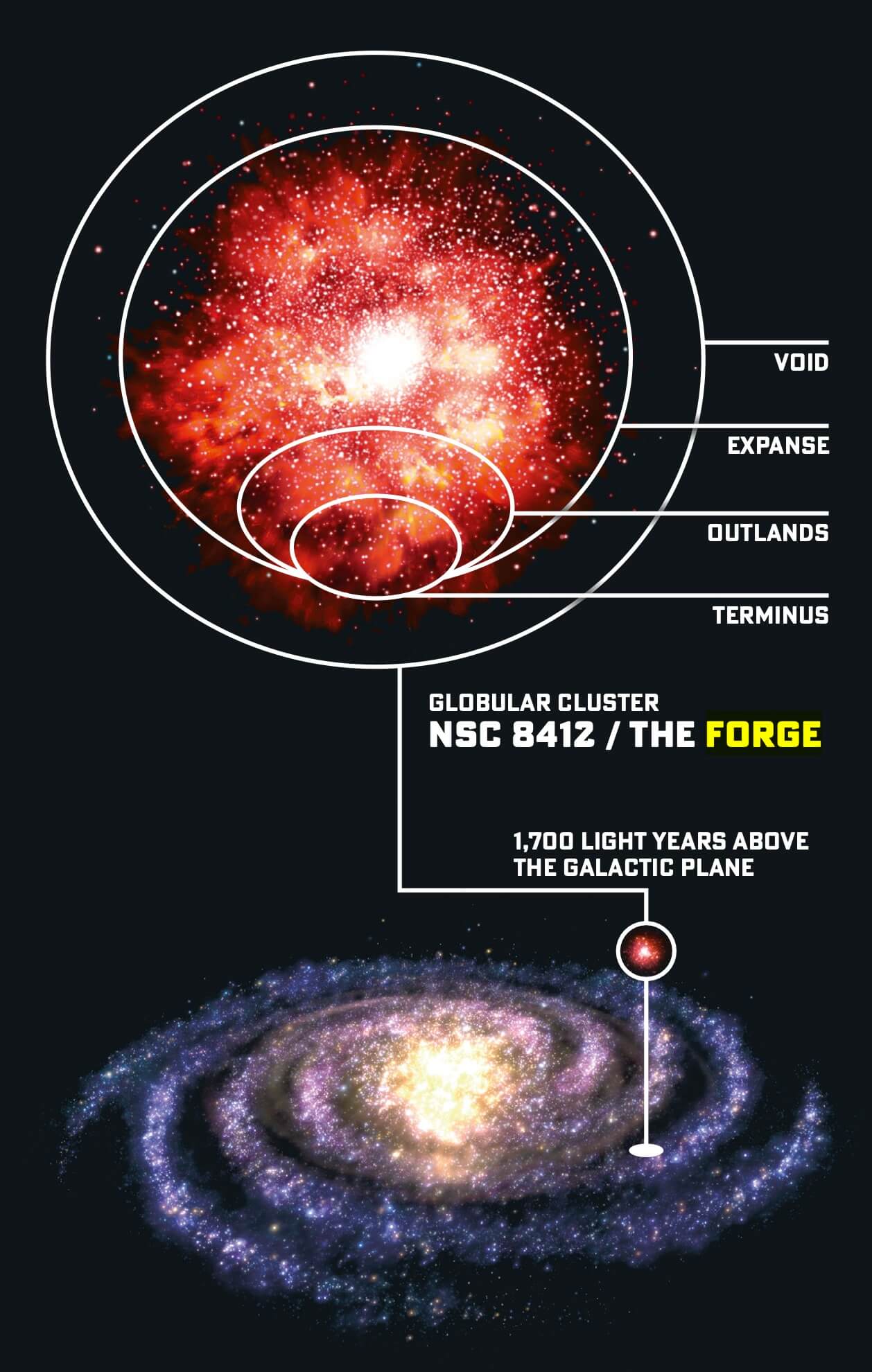
The Forge serves as the setting for your adventures. It’s a place where humanity has a foothold in a settled region called Terminus, a less-settled frontier called the Outlands, and a vast unexplored Expanse beyond. The game gives you a nice starting point while still giving you endless possibilities to create your own universe and stories within it.
A tenet of solo RPG is that prep is play. Starforged has a good amount of prep, helping you create your world and a character to explore it, before your adventure even begins. But as soon as you crack open the book (or PDF), you are considered to be playing the game. Learning about the game, preparing for your adventure, and creating your character is all part of playing the game.
Oracles
Before I go any further, it’s worth mentioning that as the book takes you through your preparation and into your adventures, you will be making a lot of decisions—what happens when your character attempts something and succeeds? What if they fail? Success or failure may be dependent on the outcome of a dice roll. Sometimes what happens will be based on your own writing and imagination—whatever you decide happens, happens.
But as you explore the Forge and take on your quests, you don’t have to shoulder the burden of inventing everything on your own. The book includes many oracles to help you along the way. These are essentially random tables that you can roll dice against to choose anything from names, places, and attributes to themes and ideas. When you’re stuck and you don’t know how to proceed, consult an oracle table or three.
I’ve really enjoyed the interplay between my own imagination, the outcome of predefined moves, and rolling against oracle tables to see what happens or to get inspiration. As we will see later, you will create areas of the Forge, called sectors, procedurally using oracle tables to define stars, planets, and settlements. It’s quite fascinating.
Setting up your world
Once you’ve learned a bit about the rules (more on this later) the book takes you through a setup process where you create the broad strokes of your world (called Truths), your player character, and a starting sector within the Forge.
Truths
This brilliant setup strategy pulled me into the world. Even among sci-fi fantasy, there can be a lot of differences in the way the world works. For example, one of the truths you choose is Magic. Does it exist in your world at all? If it does, is it really just technology and not magic in the true sense of the word? Or does magic flow through your universe, powering all sorts of unnatural abilities? The choice is yours. The book gives you three options to choose from (roughly the ones I mentioned), which you can roll dice for if you want an element of chance. But you are also welcome to write your own definition or modify the ones they provide. There are no limits here.
You move through these truths defining how religion works, how communication works, what was the cataclysm that made humans flee to the forge in the first place, etc. As you work through the truth categories, you build out a unique world little by little. This section in particular got my creative juices flowing. Sometimes I would take options from the book wholesale, other times I would write my own. As I was working through, I started having ideas for my character already. I started visualizing places in the Forge. I find that this rich starting point gave me a lot of creative ideas. A lot easier than a blank page, that’s for sure!
Create your character
Creating a character in Starforged is similar to doing it in other games like D&D. Starforged focuses on humans, so there isn’t really an equivalent to species like D&D has. Of course, this is your game, so you’re free to do whatever you want. But the game offers a number of paths, which are somewhat similar to selecting a class in D&D.
For example, I chose these two paths for my character: Courier and Empath.

Transcript of card text
PATH: COURIER
When you Swear an Iron Vow to transport and protect something precious, set its safety to 5. When you Undertake an Expedition or Set a Course and score a weak hit or miss, you may suffer -1 safety as the cost. On a miss with a match, you must suffer -2 safety as the cost. When safety falls to 0, envision a major complication related to this mission. If you overcome the threat, mark progress twice on this quest. Then, set safety to 3.
When you Fulfill Your Vow to an unbonded connection by completing a courier mission, mark progress twice on the relationship.
When you Sojourn during a courier mission, you may roll +safety. On a strong hit, take +1 safety or +1 momentum.
Safety track: 5 4 3 2 1 0
PATH: EMPATH
When you read the intent, emotions, or memories of a nearby being, roll +heart. On a strong hit, you glimpse a helpful aspect of their inner self. Envision what you learn, take +2 momentum, and add +1 when you make moves to interact with them in this scene. On a weak hit, the visions are murky; take +1 momentum. On a miss, you reveal a troubling motive or secret; Pay the Price.
As above, and if you score a hit as you read them, you may subtly influence their attitude or actions, such as making a hostile being hesitate. Take another +1 momentum. If in a fight, mark progress.
When you Face Danger to soothe a being’s distress by creating an empathic bond, roll +spirit and take +1 momentum on a hit. If they are an ally, also give them +2 spirit on a hit.
These cards are called assets and there are different categories. As you create your character, you will have the choice between different asset cards. Each one grants you certain features and abilities, or represent something you can use (like your starship, for example).
The book will guide you through creating a backstory for your character. You’ll use your paths as inspiration and of course there are oracle tables if you need them. You’ll also give your character a background vow. This is a sort of long term mission or quest your character has taken on.
You’ll also assign stats to your character:
- Edge: quickness, agility, and prowess when fighting at a distance.
- Heart: courage, willpower, empathy, sociability, and loyalty.
- Iron: physical strength, endurance, aggressiveness, and prowess when fighting at close quarters.
- Shadow: sneakiness, deceptiveness, and cunning.
- Wits: expertise, knowledge, and observation.
Once you flesh out a few more details and name your character, you’re ready to set up a starting location.
Starting sector
A neat aspect of Starforged is generating the areas that your character will explore. You do it by a mix of your own whims, a few rules, and a healthy dose of oracle table rolls.

You end up with a couple of settlements of interest you can explore. The neat thing about it is that you generate some surface level information about every settlement in your starting sector, but you don’t need to worry about giving a specific area more detail until you actually arrive there. At that point, you can roll on oracle tables or look through the different types of locations to flesh out the area—what it looks like, what its laws are like, even what kind of trouble you’re in when you arrive, if any.
Swearing an iron vow
Swear an Iron Vow is how you accept a quest in Starforged. It’s an official move your character can make. Your character will usually quite literally hold a piece of iron that is important to them and make the vow of the thing that they are trying to accomplish. Mechanically, this will generate a progress meter that you will then make moves toward filling up and completing. Once you swear your first iron vow, you are ready to begin your adventure.
The rules system
I’m not going to rehash all the rules here as the book does a much better job than I can do of explaining them. But I will give you an idea of the mechanics of the gameplay. The book has a list of moves and what kind of events will trigger those moves. The rule system is based on the popular Powered by the Apocalypse system. Many TTRPGs have been created using this system as a base. I’ve written about one of them—Monster of the Week.
Dice
In Starforged a “move” is a mechanic that requires rolling dice and determining the outcome based on whether the result was a strong hit, a weak hit, or a miss. You roll a d6 called an action die against 2d10, called challenge dice. You’re always rolling a stat, similar to D&D, so add you add the appropriate stat bonus. You then add any other bonuses given by features or the situation. The sum of your d6 plus these bonuses is your action score.
- Strong hit: your action score is higher than each challenge die
- Weak hit: your action score is higher than one of the challenge dice
- Miss: your action doesn’t beat either challenge die
Ties go to the challenge dice.
Depending on what move you’re making, you may have the option to choose which stat to roll. I’ll give you an example.
Your character is traveling across the sector through an uncharted path to an outpost settlement. You make the move Undertake an Expedition. That move has a detailed description and it gives us three options for which stat to roll, depending on how the character is approaching the situation. My character opts to stay vigilant, rolling +wits. If his wits stat is 2, a roll might look like this:
- 1d6: rolled a 3
- 210: rolled a 4 and a 7
My action score is 5 (my d6 + wits) and that beats the one challenge die (the 4) but not both. This is a weak hit. The move description says that on a weak hit I make progress, but the progress costs me. How it costs me, story-wise, is up to me. The move description gives me some options for how to mechanically handle a weak hit.
Moves
I’ve discussed a few moves now, but it’s important to note that not everything is a move. In Starforged moves represent something important, uncertain, that has the possibility of failure and consequences. If I want to ride my hover bike across a bustling futuristic city so that I can question an old friend, I can just do that. It’s not particularly dangerous. I don’t need to Undertake an Expedition. If I’m confronting something dangerous or I’m discovering something important to a quest or entering into combat, these are the types of things that will require a move.
If you’re curious, here is the description text for one of the moves.
Undertake an Expedition
When you trailblaze a route through perilous space, journey over hazardous terrain, or survey a mysterious site, give the expedition a name and rank.
Then, for each segment of the expedition, envision your approach. If you…
- Move at speed: Roll +edge
- Keep under the radar: Roll +shadow
- Stay vigilant: Roll +wits
On a strong hit, you reach a waypoint. Envision the location and mark progress per the rank of the expedition.
On a weak hit, as above, but this progress costs you. Choose one.
- Suffer costs en route: Make a suffer move (-2), or two suffer moves (-1).
- Face a peril at the waypoint: Envision what you encounter.
On a miss, you are waylaid by a crisis, or arrive at a waypoint to confront an immediate hardship or threat. Do not mark progress, and Pay the Price.
I won’t describe all the moves here as, again, the book does that much better. But I will say that the book does a nice job of categorizing the moves and giving you enough to feel like there are options, but not so many as to be bewildering.
Progress
Whenever you are trying to accomplish something, be it a quest, a journey, or improving a relationship with an NPC, you will track the progress on what Starforged calls a progress track.
You can think of it as a series of ten checkboxes. Depending on how you’ve ranked the difficulty of that track will inform how many boxes you’re able to check off whenever significant progress is made. This gives you a clear structure for knowing when you are close to completing something. In my case, I’m writing my game as a story, so when I make progress and I’m reaching the end of a track, that will prompt me to guide the fiction, that quest or expedition, whatever it is, to an ending.
Advancement
As you fulfill your iron vows—your quests—you will have the opportunity to advance your character and gain new features and abilities.
Starfall: my Starforged playthrough
I’m trying out solo RPG for the first time as a way to inspire me to write creatively more often than what I’ve done in the past (which was essentially to attempt NaNoWriMo once a year). As a way to keep me motivated—and also as an excuse to make another website—I decided to publish my game on the web.
https://starforged.blakewatson.com/
At the time of this writing, I’m a few chapters in. I’m posting chapters of my game as I play them. This isn’t great fiction or anything, but I’m trying to make it somewhat interesting as a story. It might also be helpful to anyone who wants to get started but doesn’t know how (I’m definitely still a n00b, though; fair warning).
How you record the antics of your character is up to you. You don’t need to write full prose like I’m attempting to do here. You can journal from your character’s perspective. You can make short bulleted lists on index cards for what happens. However you would like to record your game is fine!
So far I’ve decided to post the main game as chapters and then fill out some of the backstory and other lore as a group of pages.
Playing in Obsidian
There are an infinite number of ways to go about playing Starforged. The book and PDF include character sheets and more for recording various aspects of the game. If I were still able to write by hand, I would probably be playing this game very IRL with a journal and physical dice, etc.
But alas, my world is mostly digital. Fortunately, there are excellent digital tools available. I have been using Obsidian for note taking for a while. Obsidian’s superpower is its wealth of quality themes and plugins that allow it to do just about anything. Obsidian is turning into org mode for non-programmers.
I’m using the fantastic plug-in Iron Vault along with a vintage color scheme and a quirky monospaced font. Iron Vault gives you an interactive character sheet. This is what mine looks like.

I’m writing my chapters in a folder called Journals. Whenever I feel it’s time to make a move, I can open the command bar and start typing the name of the move. Iron Vault will roll dice for me (with animations included) and then output a nice display of the results directly into my text.

First impression and closing thoughts
I often spend my holiday break catching up on personal coding projects. I lovingly call this my holiday sprint. But for the second week of my two weeks off in December, I started playing this game as a way to chill out and slow down. I found it relaxing and freeing—the writing didn’t have to be great because it’s a game and it’s for myself. It gives me an excuse to play to see what happens (another core tenet) and not to get hung up on the little things. As I said, I’m using it as a way to write more. You might approach it differently. Totally fine!
I’m impressed with the flexibility of this game. The fact that you can play it solo without a GM or with a GM is pretty impressive. You can tell the creator took a lot of time to get the design and artwork and ethos of the book just right.
I envision my game as a long-term project. I’m not trying to release chapters on a schedule. When I felt like I want an escape, I will play. And if I play, I will post.
This has been pretty enlightening and now I’m curious about games that have less rules and mechanics. With Starforged, I sometimes have decision paralysis about when to activate a move, but so far I am managing. On the other hand, solo journaling RPGs, as I described, have even less mechanics and rely even more on journaling and writing. I think that could be fun too, and I may try one of those next.
If you’ve read this far and you have any experience playing solo RPGs, let me know how you are enjoying them and what your approach is. You can email me (below) and I’m on Mastodon.